Georgia Workers' Comp Audit: Why You Were Charged for Your Subs (Year-End Certificate Checklist)
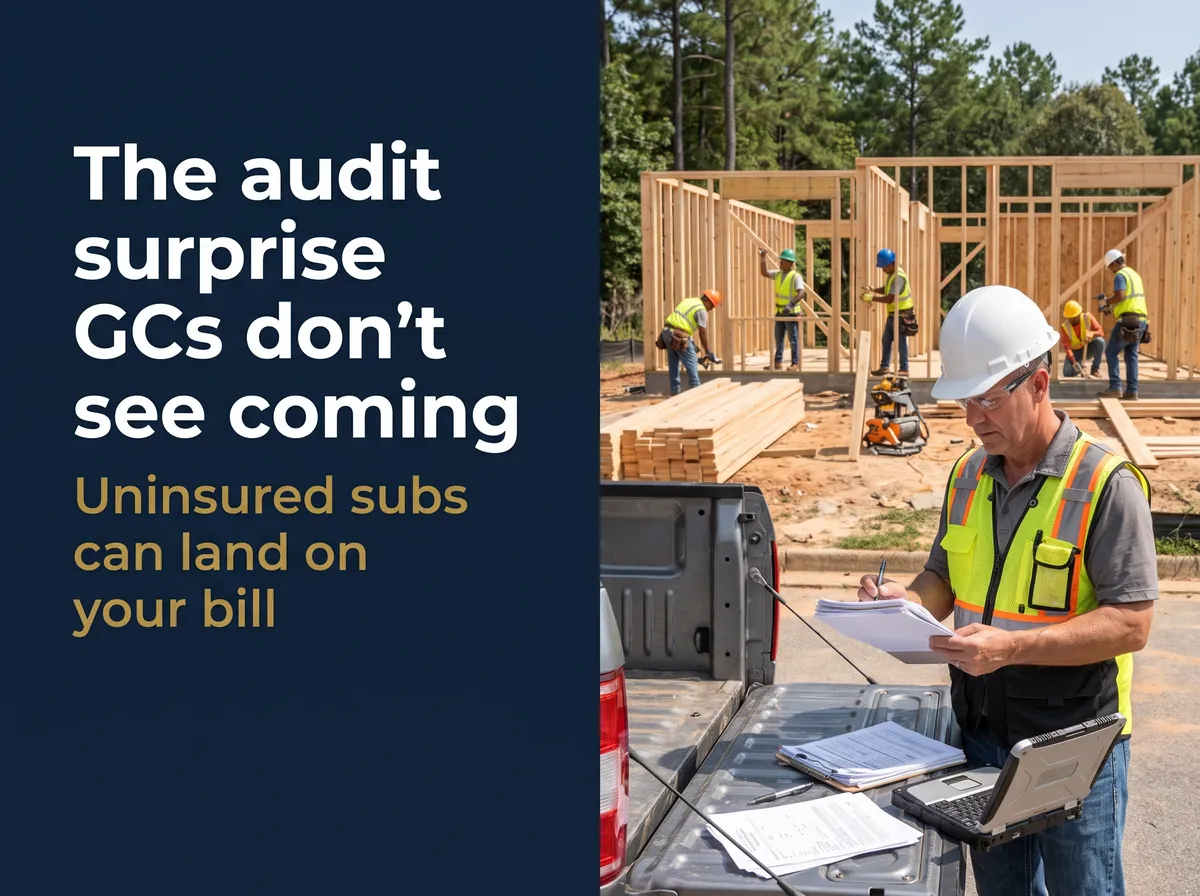
Short answer: In Georgia, a contractor can be treated as the "statutory employer" of an uninsured subcontractor's workers (O.C.G.A. § 34-9-8). So when your workers' comp policy is audited, the carrier can add what you paid an uninsured sub to your payroll and bill you for it. The fix is a current certificate from every sub, checked before they start and kept on file for the audit.
If your policy renews on January 1, your audit is coming in the next few months. The work you do between now and year-end decides how that bill looks.
Why the audit charged you for your subs
Your workers' comp premium is estimated when the policy starts, then corrected at the end of the term with a premium audit. The auditor looks at your payroll and at what you paid subcontractors.
- Insured subs: if a sub had their own workers' comp in force while they worked for you, and you can prove it, their payments usually stay off your bill.
- Uninsured subs: if you can't show a valid certificate for the dates they worked, many carriers treat what you paid them as your payroll and charge premium on it at the rate for the work they did.
- Labor and materials: if a sub's invoice doesn't separate labor from materials, some carriers count the whole invoice. That can make a small job expensive.
The reason is Georgia law. Under O.C.G.A. § 34-9-8, a principal contractor can be liable for workers' comp to an uninsured sub's injured employee, to the same extent as that sub. Your carrier is covering that exposure, so it charges for it.
The year-end certificate checklist
Work through this for every sub you paid this policy year:
- Get a certificate for workers' comp and general liability. A GL-only certificate doesn't help your workers' comp audit.
- Check the dates. The policy period has to cover the dates the sub actually worked, not just the day you received the certificate.
- Match the names. The named insured on the certificate should match the business name on the sub's invoices and W-9.
- Check the state. The workers' comp coverage should apply in Georgia.
- Watch for ghost policies. A sub with a minimum-premium "ghost" policy may exclude the owner and cover no employees. If that sub brings helpers, those helpers can come back to you at audit. How ghost policies work in Georgia.
- Ask for split invoices. Labor and materials on separate lines, where your carrier allows it.
- Keep one folder per sub. Certificates, invoices, W-9s and 1099s together, ready for the auditor.
Missing a certificate? Fix it before the auditor asks
- Ask the sub's agent, not just the sub. If the sub was insured during the job, their agent can issue a certificate showing the policy dates.
- Don't accept a certificate that starts after the job ended. It won't show coverage for the work you paid for.
- If the sub truly had no coverage, expect that payroll to be charged. Plan for it, and don't use that sub again without a certificate.
Already got an audit bill that looks wrong?
You can ask the carrier to review the audit. Send any certificates the auditor didn't have, plus invoices that separate labor from materials. Many audit bills shrink once the missing paperwork shows up. Do it quickly, because carriers set deadlines for disputes.
We review audit bills for Georgia contractors at no cost. Book a free audit and risk review.
How our clients stay ahead of it
Quinn Alliance clients get a portal that helps track sub certificates and flags items to review, like expired policies, low limits or missing endorsements, so you know what to ask for before the sub starts. It helps you stay organized. It doesn't replace collecting current certificates or the carrier's audit.
We also shop multiple carriers and specialty markets, so your program fits how you build. General contractor insurance in Georgia.
Georgia GC with an audit coming up?
Get a free review of your sub certificates and last audit before the next one lands.
Book a free review or call (470) 648-6767.
FAQ
Does Georgia require workers' comp for contractors?
Georgia requires workers' comp for most businesses with three or more employees, including part-time employees. Many general contractors also require it from every sub by contract, even a one-person sub.
Can I be charged for a sub who had their own insurance?
Usually not, if you can show a certificate proving their workers' comp was in force on the dates they worked. The problem is almost always missing or expired paperwork.
What is a statutory employer in Georgia?
Under O.C.G.A. § 34-9-8, a principal contractor can be liable for workers' comp benefits to an uninsured subcontractor's injured employee on the job. That liability is why carriers charge premium for uninsured subs at audit.
When does a workers' comp audit happen?
After your policy period ends. If your policy renews January 1, expect the audit request in the first months of the year.
By Frank Quinn, Principal Agent, Quinn Alliance LLC, specializing in construction trades and businesses in Georgia. GA License #244699. Georgia businesses only. Educational only. Coverage depends on your policy terms.