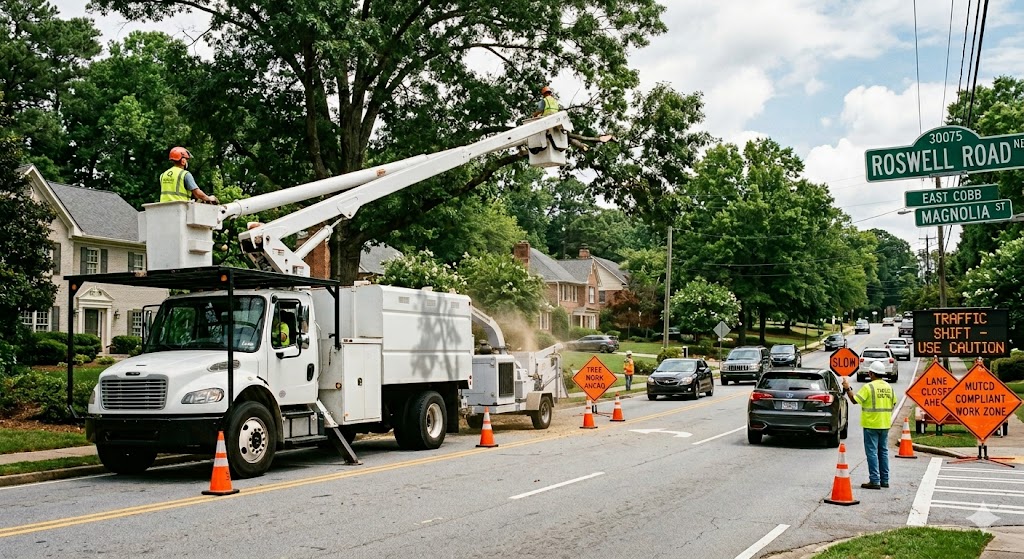
Roswell Tree Removal Permits and Roadside Liability: A 2026 Guide for Georgia Tree Crews
Short version: In the City of Roswell, the company doing the cutting is responsible for having a valid tree permit on site. Specimen trees are protected on every lot, and cutting one without a permit costs $1,000 per tree density unit before any other penalty. A Roswell mailing address does not always mean Roswell rules apply. And when a vehicle hits your truck or chipper on the road, it is usually your commercial auto policy, not your general liability, that responds.
By Frank Quinn, Agency Principal, Quinn Alliance LLC. GA Agency License #244699. Updated September 28, 2026.
Who is responsible for the tree permit in Roswell?
The tree company is. Roswell's Unified Development Code (UDC) Section 12.1.3.A applies the tree removal rules to anyone removing trees on behalf of another person, including tree removal companies. It is unlawful for any person or company to remove a tree unless a valid permit is in effect and displayed on the site. If there is no permit posted, the crew doing the work is in violation, not just the homeowner.
What needs a permit:
The general rule (UDC 12.1.1.B.3): no one may remove, damage, trim or transplant a tree that is 3 inches or more in diameter at breast height (DBH) and normally reaches 15 feet or taller without first getting a permit.
The single-family exemption (UDC 12.1.1.C): non-specimen trees on a lot under 1 acre zoned or platted for a house are exempt from most of the tree rules. But the code still requires a tree removal permit application to show the exemption applies. In practice: file the application.
Specimen trees: protected on every lot, of any size. More on this below.
Hazard trees: a tree that has become, or threatens to become, a danger to people or property is exempt only when the City Arborist makes that call. A crew or homeowner cannot declare a tree hazardous on their own.
Near the river: the city asks owners within 2,000 feet of the Chattahoochee River to contact Planning and Zoning before removing trees.
Specimen trees: the rule that applies to every lot
Roswell defines a specimen tree (UDC Section 14.2) as a tree in fair or better condition that meets these sizes:
Tree type | Examples | Specimen size (DBH) |
|---|---|---|
Small trees | Dogwood, sourwood, cherry | 8 inches |
Midstory trees | Maple, birch, magnolia, holly | 16 inches |
Overstory hardwoods | Oak, hickory, sweetgum, ash | 20 inches |
Overstory softwoods | Pine | 30 inches |
Removing a specimen tree takes a written justification and Engineering Director approval after City Arborist review (UDC 12.1.3.B). The money side:
Approved removal: $500 per tree density unit, paid to the Roswell Tree Bank.
Removed without a permit, or before one was issued: $1,000 per tree density unit. If there is no tree survey, the city sizes the trees from the stumps. If there are no stumps, each tree is presumed to be 20 inches DBH.
General violations (UDC 13.14.4): fines of up to $2,000 per day, with each day counted as a separate offense after a 30-day notice to cure. The city can also withhold or revoke permits and licenses.
For a tree company, the takeaway is simple: a specimen oak removed on a handshake can turn into a four-figure bill per tree plus fines, and those costs land on the business that cut it.
A Roswell address is not always Roswell
Roswell is in Fulton County, but mailing ZIP codes do not follow city limits. By land area, ZIP code 30075 is roughly 84% Fulton County, 14% Cobb County and 2% Cherokee County, according to the U.S. Census Bureau's 2020 ZIP-to-county relationship file. ZIP 30076 is in Fulton. A job with a "Roswell, GA 30075" address can sit in unincorporated Cobb or Cherokee, where Roswell's ordinance does not apply and the county's rules do.
Check the parcel, not the mailing address. The county tax assessor or GIS parcel viewer will show whether a property is inside city limits.
Unincorporated Cobb County
Cobb's tree ordinance (Cobb County Code Chapter 50, Article VI, Tree Preservation and Replacement) applies to activity that requires a Land Disturbance Permit. Routine landscaping, repairs and maintenance are exempt from land disturbance permitting (Section 50-74). So a routine removal on an existing home lot that is not being developed generally does not trigger a county tree permit. Stream buffers, zoning conditions and HOA covenants can still restrict a specific lot, so check before you cut. Where the ordinance does apply, the civil penalty is 10% of the cost of correction, and never less than $1,000, with each day a separate offense (Section 50-231).
Neighboring cities your crews work in
City | Permit on an existing home lot? | Key thresholds |
|---|---|---|
Roswell | Yes for specimen trees; application to confirm the exemption otherwise (lots under 1 acre) | 3 inches DBH general rule; specimen sizes above |
Sandy Springs | Yes, when not part of construction | 18 inches DBH and up; dogwood or redbud 10 inches and up; trees in stream buffers. Dead or hazardous trees: documentation to the City Arborist first |
Milton | Yes | 15 inches DBH and up; small canopy trees (dogwood, redbud) 8 inches and up; trees in stream or zoning buffers |
Alpharetta | Yes, approval before removing any living tree on single-family residential property | City runs an Authorized Tree Removal Contractor Program for trained contractors |
Unincorporated Cobb | Generally no, unless the work requires a Land Disturbance Permit | Buffers, zoning conditions and HOA rules can still apply |
Ordinances change. Confirm with the city arborist or county before each job.
Roadside work: what the rules actually say
A lot of tree work happens with a bucket truck or chipper on or next to a public road. The standard for traffic control in those zones is Part 6 of the Manual on Uniform Traffic Control Devices (MUTCD), published by the Federal Highway Administration. Georgia's State Transportation Board adopted the 11th Edition on June 20, 2024.
It covers your kind of work. Part 6 applies to utility work and maintenance operations on roads open to public travel, including shoulder work. It also covers short-duration jobs (up to 1 hour) and mobile operations, and it says safety should not be compromised by using fewer devices just because the job moves or is short.
A work zone has four parts: the advance warning area (signs ahead of the work), the transition area (the taper that shifts traffic), the activity area where you work, and the termination area where traffic returns to normal.
People: flaggers must be qualified, and workers in the zone wear ANSI/ISEA 107 Class 2 or 3 high-visibility apparel.
Distance matters: the manual's guidance generally does not call for traffic control when work stays 15 feet or more from the edge of the travel lanes.
Permits for the road itself: work in a state route right-of-way generally needs a GDOT permit, and many cities require a lane or street closure permit before you block a lane. Check with the GDOT district office or the city before the job, not after.
OSHA's construction standards (29 CFR 1926.200 and 1926.201) require traffic control devices and flagging to conform to MUTCD Part 6. Most tree care falls under OSHA's general industry rules instead, but after a crash, Part 6 is the benchmark people will measure your setup against.
How fault gets split after a roadside crash in Georgia
Georgia's apportionment statute, O.C.G.A. 51-12-33, controls how fault is divided:
A plaintiff's damages are reduced by their own percentage of fault.
A plaintiff who is 50% or more at fault recovers nothing.
Each defendant pays its own share of fault, and the jury can consider the fault of everyone who contributed, even people who are not named in the suit.
What that means for a tree company: a distracted driver does not automatically mean your business pays nothing. If your truck placement, missing signs or lack of a flagger contributed, a jury can assign your company a percentage. This is general information, not legal advice.
Which policy answers when something goes wrong
A crash involving your truck, chipper or trailer on the road: usually a commercial auto liability claim. General liability policies exclude most injuries arising from the use of autos. Make sure every truck, chipper and trailer is covered on the auto policy.
Damage from the tree work itself (a limb on a parked car, a tree on a roof, an injured bystander): general liability. Check that the policy's classification matches what you actually do: trimming, removal, climbing, crane work. Many tree policies limit height, crane use or work near power lines, and a claim outside the described work can be denied.
Crew injuries: workers' compensation. Georgia requires it once a business regularly has 3 or more employees, and at audit a carrier can charge you for subcontractors who could not show their own coverage. Solo operators should read our guide to ghost policies and workers' comp with no employees.
Permit fines and tree bank fees: liability policies are written to pay damages for injury or property damage, not government fines or permit fees. Plan on those coming out of pocket, which is the best reason to pull the permit.
Subcontractors: get a current certificate before they start. Many specialty tree policies expect subs to carry their own liability coverage and name you as additional insured.
Equipment: chippers, stump grinders and climbing gear are usually covered under an inland marine (equipment) policy. Trucks and trailers go on the auto policy.
Pre-job checklist for Roswell-area work
Look up the parcel and confirm the jurisdiction: city of Roswell, Sandy Springs, Milton, Alpharetta, or unincorporated Cobb or Cherokee.
Measure DBH and identify species. Flag anything at specimen size.
File the permit or exemption application. Post the permit on site before the first cut.
If the tree is a hazard, get the City Arborist's determination in writing before removal.
If a truck, chipper or crew will be on or near the road, plan the work zone: advance warning signs, taper, flagger, high-visibility apparel. Get any lane closure or right-of-way permit.
Collect current certificates from every subcontractor.
Take timestamped photos of the setup before work starts.
Haul off all trees, stumps, limbs and debris. Roswell requires tree companies to remove them from the site.
Frequently asked questions
Do I need a permit to remove a tree in Roswell, Georgia?
Usually yes. Roswell requires a permit for trees 3 inches DBH or larger that normally reach 15 feet. Non-specimen trees on single-family lots under 1 acre are exempt, but you still file an application to confirm the exemption. Specimen trees need a permit on every lot.
Who gets fined if a tree is cut without a permit in Roswell?
The code makes it unlawful for any person or company to remove a tree without a valid permit displayed on site, and it applies to tree removal companies working for someone else. The contractor can be cited, not just the owner.
Does unincorporated Cobb County require a tree removal permit?
Cobb's tree ordinance is tied to Land Disturbance Permits, so a routine removal on an existing home lot generally does not need a county tree permit. Buffers, zoning conditions and HOA covenants can still apply.
Is a Roswell mailing address always inside the City of Roswell?
No. ZIP code 30075 extends into Cobb and Cherokee counties. Check the parcel's jurisdiction with the county assessor or GIS viewer before you quote or cut.
Does general liability cover a car hitting my parked bucket truck?
Usually not. Injuries arising from the use of autos are generally excluded from general liability and handled by commercial auto liability. Make sure every truck and towed chipper is covered on your auto policy.
Get a tree service insurance review
Quinn Alliance is a licensed Georgia agency that places climbing, crane and removal work with specialty markets built for tree care. We check that your classification, auto coverage and subcontractor requirements match the work your crews actually do. See Georgia tree service insurance, start a quote, or call (470) 648-6767.
Sources
City of Roswell Unified Development Code, Article 12 (Sec. 12.1 Tree Protection), Article 13 (Sec. 13.14 Enforcement and Penalties) and Article 14 (Definitions). library.municode.com
City of Roswell, Trees FAQ. roswellgov.com
Cobb County Code of Ordinances, Chapter 50, Article VI Tree Preservation and Replacement, and Sec. 50-74 Exemptions. library.municode.com
U.S. Census Bureau, 2020 ZCTA to County Relationship File. census.gov
City of Sandy Springs, Tree Removal Permits. sandyspringsga.gov
City of Milton, Tree Removal Guidelines. miltonga.gov
City of Alpharetta, Residential Tree Removal. alpharetta.ga.us
Federal Highway Administration, MUTCD 11th Edition, Part 6 Temporary Traffic Control. mutcd.fhwa.dot.gov
Georgia DOT, Chief Engineer memo on adoption of the 11th Edition MUTCD (2024). dot.ga.gov
Georgia DOT, Regulations for Driveway and Encroachment Control. dot.ga.gov
O.C.G.A. 51-12-33, Apportionment of damages. law.justia.com
OSHA, 29 CFR 1926.200 and 1926.201, and OSHA Tree Care standards overview. osha.gov
Georgia Office of Insurance and Safety Fire Commissioner, verifying workers' compensation coverage and avoiding audit surprises. oci.georgia.gov
General information for Georgia tree service businesses, not legal advice. Codes and ordinances change; confirm current requirements with the city arborist, county or GDOT before work. All coverage is subject to carrier underwriting, policy terms and exclusions.