Georgia Electrician Insurance: What the State, GCs and Your EV and Solar Work Actually Require (2026)
Short answer: Georgia electricians typically need general liability, workers' comp once they have three or more employees, commercial auto for work vehicles, and tools and equipment coverage. The state license itself doesn't set a general liability minimum, but the general contractors, property managers and commercial clients you work for usually do, often $1 million per occurrence with additional insured status. If you've added EV chargers, solar, batteries or standby generators, check that your policy lists that work.
What Georgia requires
- Licensing: electrical contractors are licensed through the Division of Electrical Contractors under Georgia's State Construction Industry Licensing Board. Class I is restricted to smaller single-phase systems; Class II is unrestricted.
- Workers' comp: required for most businesses with three or more employees, including part-time. Many GCs require it from every sub, even a one-person shop. No employees? A ghost policy may get you the certificate.
- Auto: Georgia's minimum auto liability limits apply to your vans and trucks, but contracts often require higher commercial auto limits.
- Permits and local rules: some Georgia cities and counties ask for a certificate of insurance when you register or pull permits.
What GCs and commercial clients usually ask for
- General liability, commonly $1 million per occurrence and $2 million aggregate
- Additional insured status for the GC or owner, often on a primary and noncontributory basis
- Waiver of subrogation on GL and workers' comp
- Workers' comp with employer's liability
- Sometimes an umbrella for larger commercial jobs
Read the insurance section of the contract before you bid. Endorsements take time to add, and a missing one can hold up a job start.
Where electrical policies leave gaps
EV chargers, solar and batteries
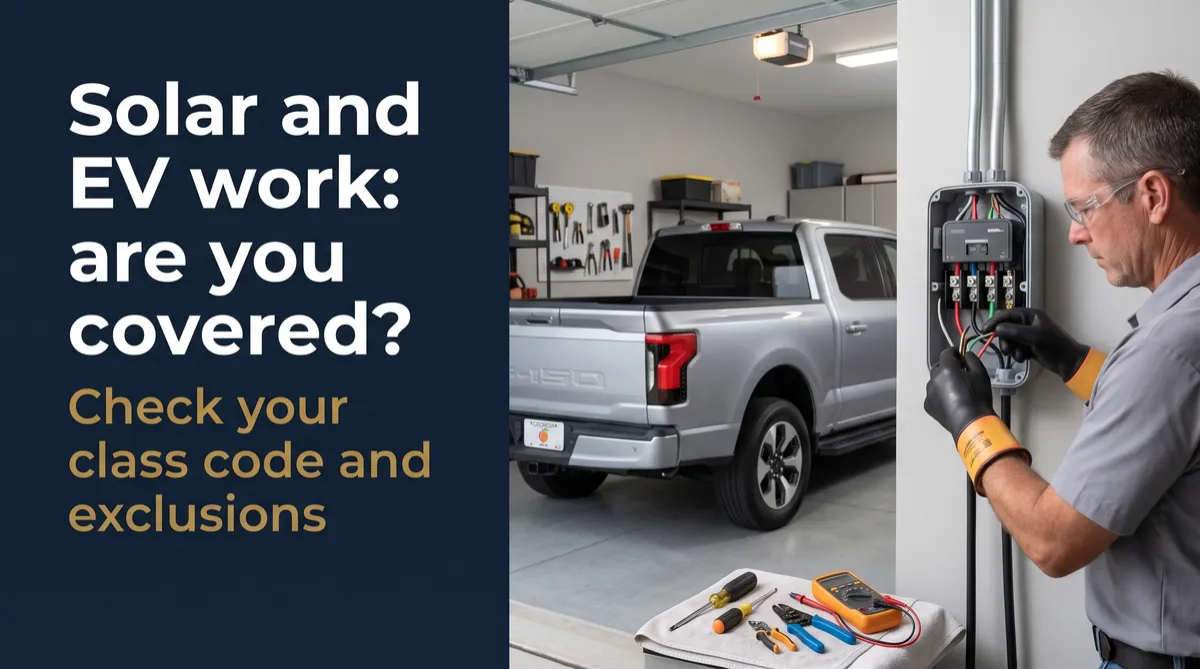
Many electrical GL policies limit or exclude solar and battery installs, or work on the utility side of the meter. If you started installing EV chargers or solar after you bought your policy, your application may not have mentioned it. A claim from work the policy doesn't list can be questioned.
Standby generators before winter storms
Fall and winter bring generator installs across Georgia. Generator work can involve gas connections and transfer switches. Make sure your classification and your policy wording cover what you actually install.
Class codes
Your premium is driven by classification. Electrical wiring within buildings is commonly classed under NCCI code 5190 for workers' comp. If the class on your policy doesn't match your work, you can overpay, or have a claim questioned.
Subs and helpers
If you sub out installs, collect current certificates before they start. Uninsured subs can be charged to you at your workers' comp audit. Why audits charge you for subs.
What makes a good electrician quote
Tell your agent exactly what you do: residential or commercial, service work or new construction, EV chargers, solar, batteries, generators, low voltage, and whether you sub out. That lets us match the classification and check exclusions before you sign. We shop multiple carriers and specialty markets to match the work you actually do. Electrical contractor insurance in Georgia.
Georgia electrician?
Start your quote online, or call and tell us what you install.
FAQ
Do electricians in Georgia need insurance to get licensed?
The state license doesn't set a general liability minimum. Workers' comp is required for most businesses with three or more employees, and most GCs, property managers and commercial clients require general liability before you can start work.
How much general liability do Georgia electricians need?
Many contracts ask for $1 million per occurrence and $2 million aggregate, plus additional insured status. Larger commercial jobs may also require an umbrella.
Does my electrical policy cover EV charger and solar installs?
Not always. Many electrical policies limit or exclude solar and battery work. Tell your agent about every type of install so the policy is written for it.
What workers' comp class code do electricians use?
Electrical wiring within buildings is commonly classed under NCCI code 5190. Your agent should confirm the code matches your actual work.
By Frank Quinn, Principal Agent, Quinn Alliance LLC, specializing in construction trades and businesses in Georgia. GA License #244699. Georgia businesses only. Educational only. Coverage depends on your policy terms.